Design Thinking Field Guide
A Design Thinking + AI collaboration toolkit for student projects: start with real people, name a real problem, and build something small enough to test.
A Note Before Reading
This Design Thinking Field Guide grew out of a problem I kept seeing in the classroom: when students are encouraged to use AI for their own projects, what often stops them is not the tool itself. It is the very beginning: What should I make? Who am I trying to help? Why is this problem worth working on?
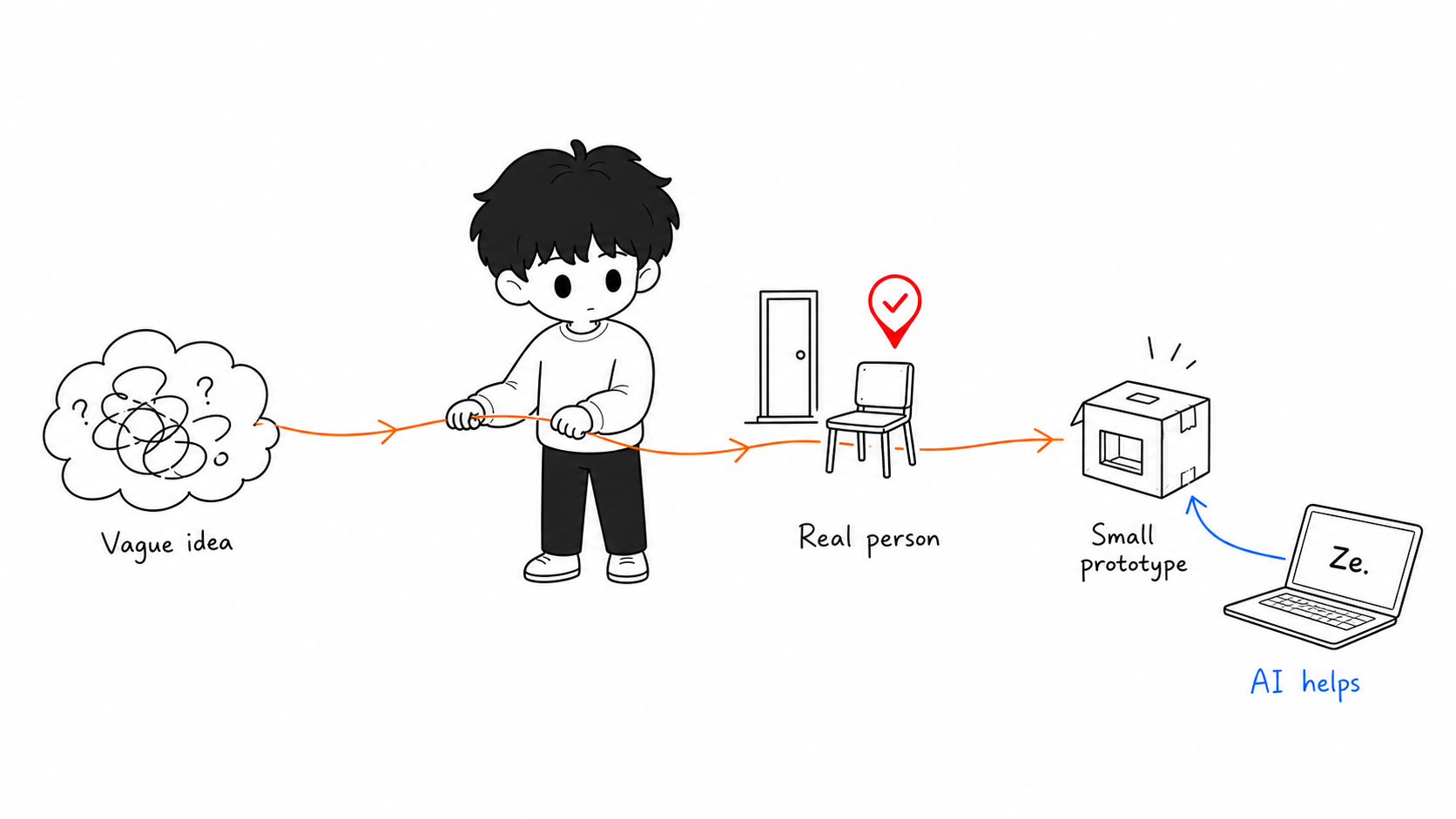
I noticed this especially in AI for Essentials, a junior-secondary elective I teach. Students can quickly learn to ask AI to search, rewrite, brainstorm, or help prototype. But when they begin their own culminating projects, the hardest part is often getting the project to stand in front of a real person. What they need is not only more AI technique, but a path for turning vague ideas into grounded, actionable projects.
That is why I think Design Thinking matters even more in the age of AI. AI can make expression, organization, and production faster, but it cannot care about a person for students, and it cannot decide which problem is worth solving. Design Thinking gives students a slower and clearer rhythm: look closely, ask better questions, make a small version, test it, and revise.
This material set breaks a project into six stages: Empathize, Define, Ideate, Prototype, Test, and Showcase. Students can move step by step, and they can always return to an earlier stage when they realize something needs to change. It can support classroom projects, workshops, hackathons, or independent student work.
Statement: The views in this article come from the author’s previous teaching materials. Claude assisted with content organization, while layout, design, and illustrations were generated through Codex using ze-design-system and ze-universe-ip. The author edited and reviewed the content to support accuracy and readability. The final views and responsibility belong to the author.
Downloads
Design Thinking Field Guide
Student handbook with the project route, six stages, AI boundaries, and prompts.
Student Worksheet Booklet
Printable worksheets for interviews, empathy maps, problem statements, prototypes, and tests.
Teacher Guide
Facilitation notes, timing options, key questions, pitfalls, and assessment guidance.
Worked Example Booklet
A worked student project that follows the process from observation to showcase.
AI Ground Rules Card
A compact student-facing card for AI boundaries and fact checks.