Our generation knows the logic of “learning English” all too well: you know English matters, so you send your child to class. As for what learning English is actually for — conversation, exams, or a ticket to a bigger world — there is rarely time to think it through.
Now it is AI’s turn.
We know AI matters, so we send kids to coding classes and AI classes. But what do we actually want them to learn? If the answer is “I hope my child becomes an AI professional,” then the path is clear: find expert teachers, take the professional route — nothing wrong with that. But we all know most kids will not take that path. What they need to learn is not how to become AI experts, but how to live, get by, and come into their own in an age where AI is everywhere.
That has a name: AI literacy.
But “AI literacy” is now said too often, and too fast. Said too often, it turns into a slogan. Said too fast, it shrinks to two questions — what is AI, and how do you use it? Both questions matter, of course. But if literacy were only those two questions, it would be far too small.
This essay wants to slow the phrase down.
1. Literacy Is an Old Word
Literacy did not arrive with AI. Other words have stood in front of it before: humanistic literacy, information literacy. Line them up and they share a secret — literacy has never been only about the word in front of it.
Humanistic literacy was never just about whether you can write a good essay. It also asks: can you read joy and sorrow in someone else’s story, can you sense what a work is really saying underneath — and do you even have the willingness and patience to try. Empathy is not a skill, yet it is the ground color of humanistic literacy.
Information literacy is far more than knowing how to search. Facing the same flood of information, some people can tell true from false; others are led around by fake news. Gathering, verifying, weighing, choosing — every judgment that revolves around “information” belongs to its territory.
Proficiency is part of literacy, but it has never been the whole of it.
By the same logic, the territory of AI literacy can only be wider. Knowing what a large model is and what context is, using the tools, writing prompts — all of this is necessary, the way knowing your letters is necessary for reading. But the deep part of literacy lies elsewhere.
When “using AI” becomes common, which non-AI capacities become scarcer?
2. What the Documents Say
Over the past two years, documents on “what students should learn” have arrived thick and fast. In 2024, UNESCO released its AI Competency Framework for Students (《学生人工智能能力框架》), drawing four dimensions: human-centred mindset, ethics of AI, AI techniques and applications, and AI system design. In May 2025, China’s Ministry of Education issued the Guidelines for AI General Education in Primary and Secondary Schools (2025 Edition) (《中小学人工智能通识教育指南(2025 年版)》), proposing a “four-in-one” literacy structure of knowledge, skills, thinking, and values. In 2026, the OECD and the European Union jointly released the AILit Framework, Empowering Learners for the Age of AI, which sorts the student–AI relationship into four moves: engage with AI, create with AI, manage AI, and shape AI. That same year, China’s 15th Five-Year Plan for Educational Development (教育发展”十五五”规划) wrote down the goal of “advancing AI education across all stages of schooling and raising students’ AI literacy.”
I have no intention of judging any of these documents. Each report has its own audience and its own mission, and together they are drawing an ever more complete map of “what to learn” — no single document can, or needs to, cover everything.
I only want to talk about one thing that lies off the map. This summer, I spent four days leading a team at a student hackathon (the full process is recorded in the first piece of this series, A Full Record of a Four-Day Hackathon, and one field story appears in Noticing Something’s Off). Over those four days, while everyone’s eyes were fixed on the new skills with “AI” in their names, I watched some much older skills being overlooked. Far from obsolete, they are becoming scarcer than ever.
collaboration, critical thinking, communication, creativity.
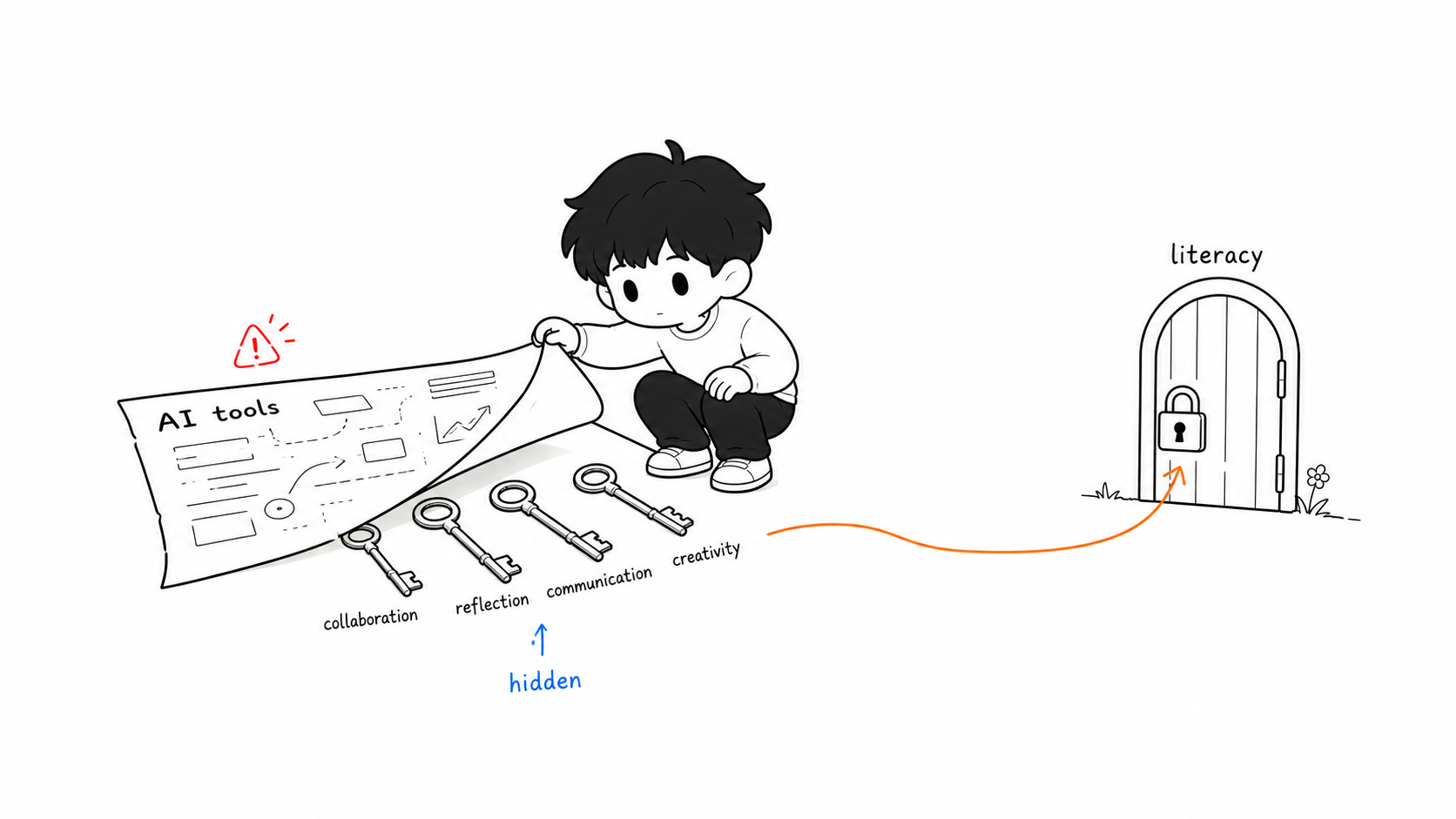
3. The Skills Without AI in Their Names
Collaboration first. The kids were good at dividing up work — you do the product, I do the poster, he does the pitch. Clean cuts, high efficiency. But divide labor long enough, and people start seeing only their own plot of land.
The night before the pitch, the finished video stalled at the very last step: the editing software was an overseas product, and exporting required buying a certificate. Team lead E and I stayed behind in the classroom, trying one workaround after another, until we finally rented an account on Taobao for a day and rescued the video. Meanwhile, the other teammates assumed the day’s work was done — they were all playing games.
The next day at the pitch, each team had one minute to present. Should the whole team go on stage? A vote picked E as the presenter, and the rest kept their heads down: “I’m not the one speaking — why should I go up?” In the end, I required everyone to stand on that stage.
I saved both stories for the final debrief. I wanted them to understand: dividing work is cutting a task apart; collaboration is treating each other’s work as everyone’s. What stands on stage is not a presenter — it is a team. This skill has nothing to do with AI. It is far older than AI, and far harder.
Then, reflection. AI’s nature is to keep moving forward: before you have digested the last answer, the next one has already been generated. Several times over those four days, I called a stop for the whole team — laptops closed, eyes on the whiteboard — using questions to pull them out of the screen: Is this what you wanted? Is it good enough? Where is it good, and where does it fall short?
These kids spent something like ten hours a day making things with computers and AI. And I have come to believe that what they learned in those ten minutes of stopping was worth no less than the ten hours.
Communication and creativity, one line each. Even “talking to AI,” the newest thing of all, has the oldest core — stating your need clearly and making your dissatisfaction specific (there is a full story about this in Noticing Something’s Off). As for creativity: AI can write the code and draw the pictures for kids, but from beginning to end it never answered the two questions that come first — what to create, and for whom? Creation does not start from a tool. It starts from seeing the need of a specific person.
4. Talk About the Person First
Back to the question we started with: what should a child actually learn?
Literacy has never been only about the word in front of it. The deep part of humanistic literacy is not the essay but empathy; the deep part of information literacy is not search but judgment. AI literacy is no different — the most important items on its list have no AI in their names.
If you are a parent, the next time your child comes running with something made with AI — a poster, a piece of code, a mini app — don’t rush to praise it, and don’t rush to frown. You can ask three questions:
- Which decisions here did you make yourself?
- Where do you think it still isn't quite right?
- What did you learn from making it?
These three questions come closer to AI literacy than any coding class.
When we talk about AI literacy, let's talk about the person first.
Back to the series: Students and AI overview | Previous: How Niaozhen Was Made: A Full Record of a Four-Day Hackathon | Continue with Noticing Something’s Off: What a Hackathon Taught Me About AI Literacy
This is the second piece in Students and AI. For details and the statement on AI use, see the series overview page.