In one sentence: technical problems get solved with version updates; ethical problems don’t. They are the responsibility that, in using AI, a human must always bear.
The previous chapters have all been about “how to use it better.” This chapter changes the angle and talks about “where you must be careful.” This isn’t to throw cold water on enthusiasm, but because a teacher’s role is special—students watch and learn from every move you make with AI. You are at once a user, a gatekeeper, and, above all, a model. The four kinds of problems below are worth loading into your mind before you act.
Bias: It Learns Human Prejudices Faithfully
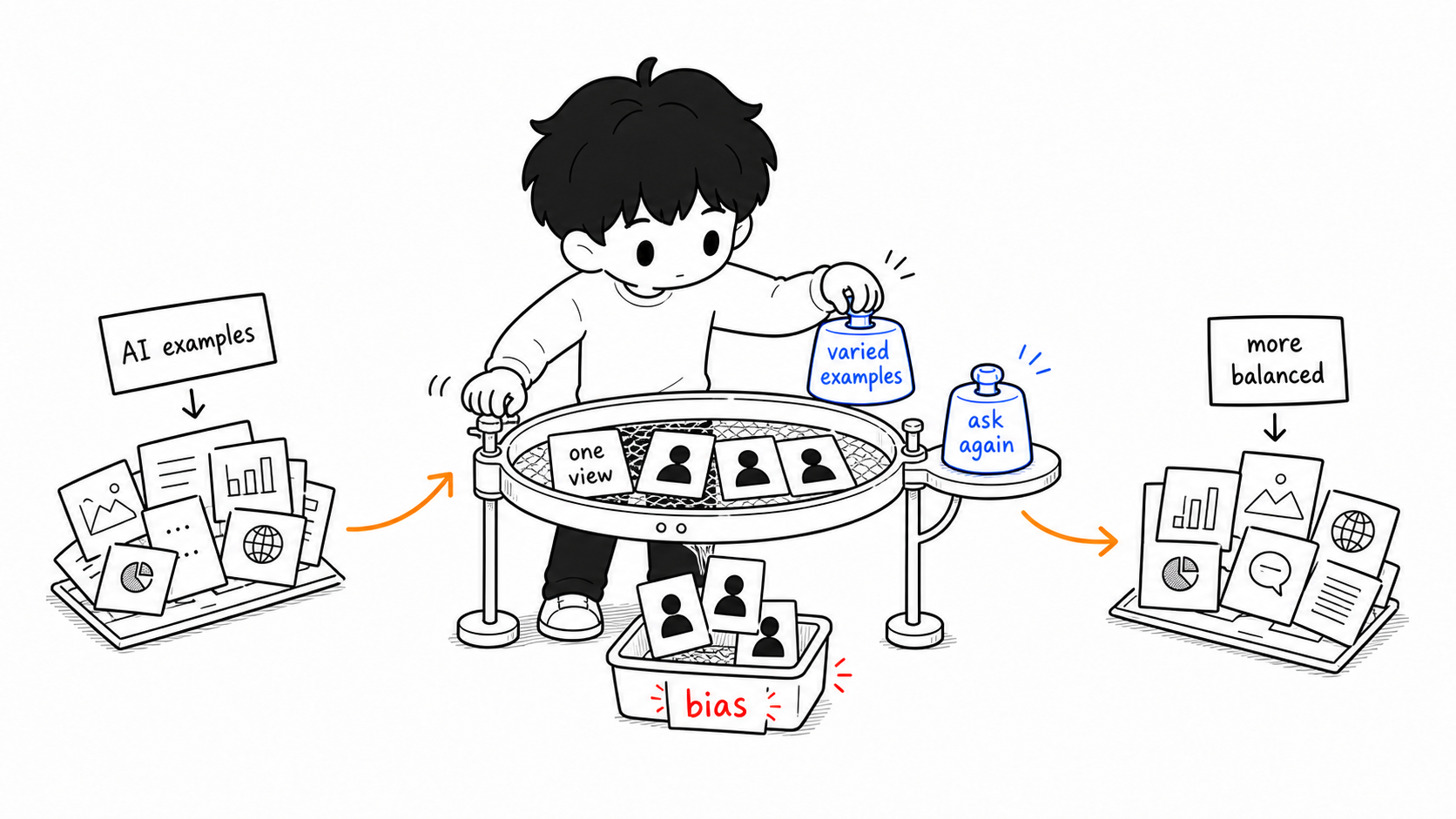
AI learns from vast amounts of text and images humans have already written, and whatever stereotypes humans hold, it learns—and sometimes amplifies—them as-is. Ask it to describe a “scientist,” and the image may be uniformly male; describe a “nurse,” and they may all be female; have it recount a stretch of history, and it may unconsciously favor the better-documented side while neglecting other regions and groups.
This bias isn’t AI being malicious—it’s a byproduct of how it works—but the consequences are real. Without vigilance, these prejudices follow your courseware and the examples you generate, quietly entering the classroom and reinforcing assumptions students shouldn’t be handed.
What a teacher can do is make “is its perspective complete?” a habit. After generating content, ask one more question: has it left out some group? Should I specifically request examples of different genders, cultures, and backgrounds? Better still, turn bias itself into teaching material—analyze the potential bias in AI-generated content together with students. That’s far more striking than simply telling them “be objective,” and it’s exactly the critical thinking that should be practiced.
Privacy: Student Data Is the Red Line You Can Least Afford to Blur
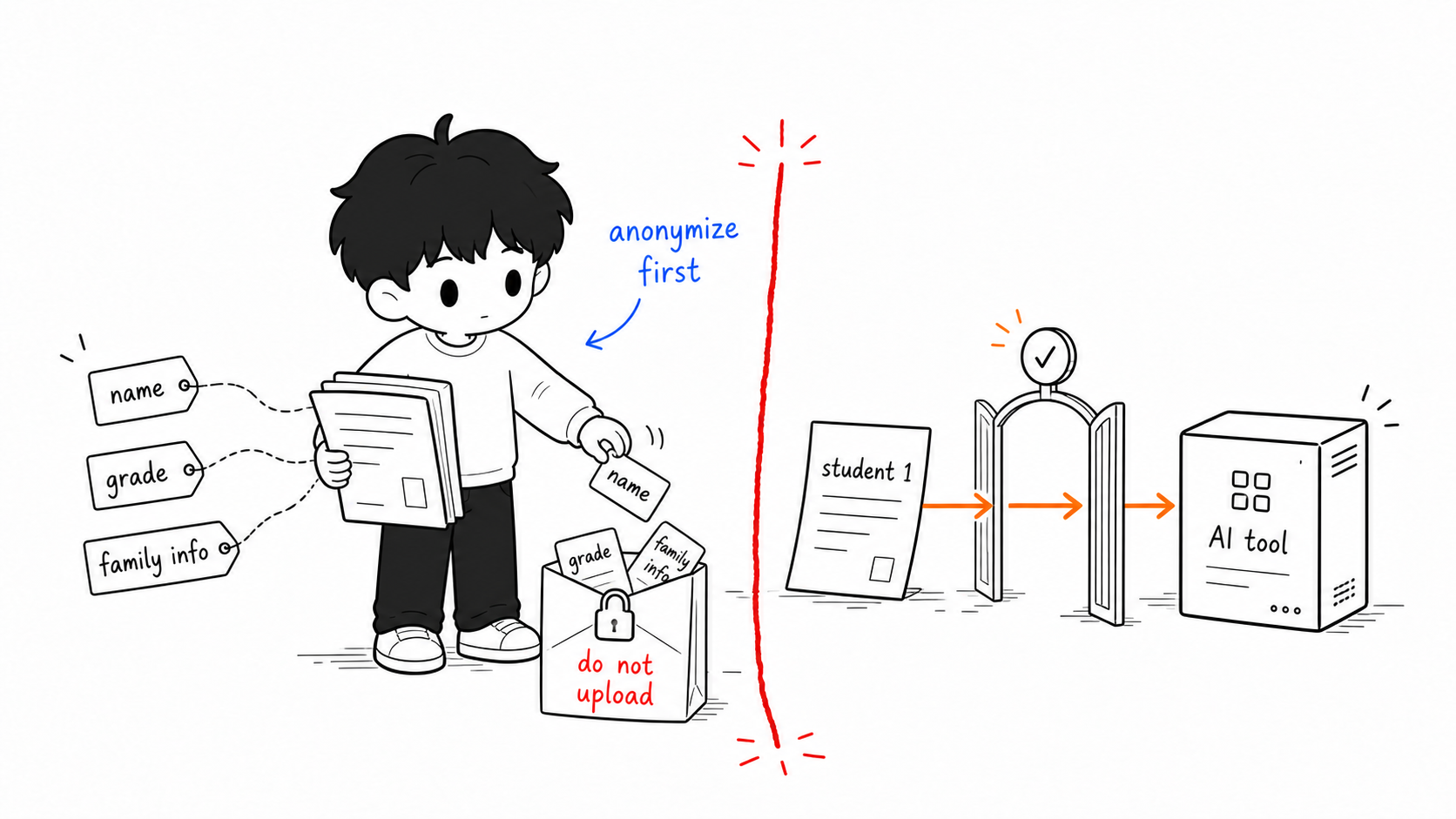
This is the most concrete and least negotiable of the four. Before handing anything to AI, hold this firmly in mind: the information you input may be used for the model’s subsequent training or retained by the service provider, and you cannot fully take it back.
From this follow several hard rules. Never upload students’ names, student IDs, grades, family circumstances, contact information, or unreleased exam content. When you genuinely need AI to help analyze homework or grades, de-identify first—remove anything that can locate a specific individual, replace it with codes like “Student 1, Student 2,” and only then hand it over. This is exactly why, in the grading workflow of the previous chapter, de-identification was listed as the un-skippable first step.
The weight of this red line outweighs any gain in efficiency. One upload made for convenience may be one irreversible leak of information. When you’re unsure whether some material can be given to AI, the default answer should be “no.”
Academic Integrity: Guide Rather Than Ban
That students use AI is an unstoppable reality, and rather than a blanket ban, it’s better to turn it into an opportunity for integrity education. The core here is helping students (and yourself) distinguish two lines.
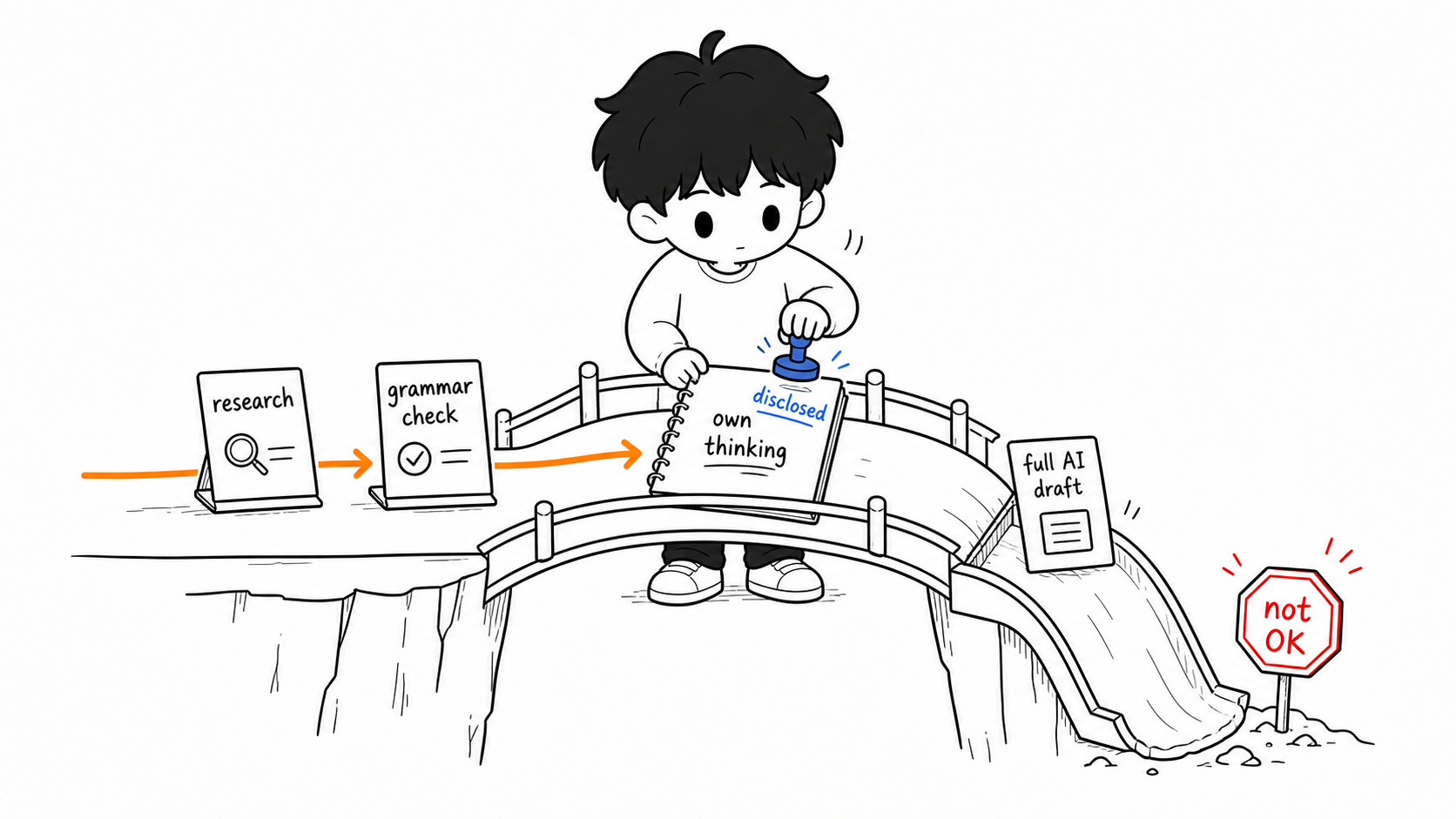
One is the line between assistance and substitution. Using AI to look up material, explain concepts, check grammar, or offer ideas when stuck—treating it as a learning partner—should be encouraged; submitting AI-generated complete work as your own—using it to replace thinking that should have been done by yourself—must be clearly prohibited. The criterion is plain: is the core thinking and expression the student’s own?
The other is the principle of transparency: whenever AI was used, it should be honestly noted. A simple homework-annotation template can look like this—
For this assignment I used [some AI] for help in the following parts:
1. Looked up the scientific principle of "photosynthesis";
2. Checked the grammar of my English essay.
I affirm that the core thinking and views are entirely my own.
Student signature: __________
The point of transparent annotation is to turn “using it secretly” into “using it openly and being accountable for it.” When using AI no longer needs concealment, the teacher has the chance to guide how it’s used well. How to turn this principle into class or school rules is the subject of the next chapter.
Copyright and Responsibility: Whose Is the Generated Content, and Who’s Accountable
The copyright status of AI-generated text and images remains unclear in many places. This means two things to watch. One is the input side: don’t feed an entire copyrighted workbook or someone else’s unpublished work into AI and then use it—that itself may infringe. The other is the output side: AI-generated content may be highly similar to existing works, and if used for publishing, distribution, or commercial purposes, exercise extra caution and ideally verify separately.
A more fundamental point is the attribution of responsibility: whether or not content is AI-generated, as long as you put your name to it and use it in class, the responsibility is yours. AI won’t answer for a wrong knowledge point or an inappropriate statement; the one who bears the consequences is always the person using it. This is also why “verification is the user’s responsibility” was stressed again and again—it’s not just a quality requirement but a responsibility requirement.
The Four, in One Line
Stay vigilant about bias, treat privacy as a red line, guide integrity, keep responsibility on yourself. None of these has a one-click switch; they all rely on the teacher personally vetting at every use.
But don’t let this make you shy away from AI. On the contrary, precisely because these problems exist, teachers who understand the boundaries and know how to gatekeep are all the more irreplaceable. Our goal was never to raise “students who don’t use AI,” but to raise people who can coexist with AI while always keeping independent judgment and humane care. To teach such students, the teacher must first be such a person. With this clarity, we move to the final chapter: how to turn these principles into policies that can be executed in schools and classrooms.
This article is part of the A Teacher’s Guide to AI series. For specific sources, references, and AI-use notes, see the series index page.