In one sentence: AI doesn’t “know” the answer—it merely predicts “the word most likely to come next.” Understand this, and you can judge when it’s trustworthy and when you must be the one in control.
Whether you use a domestic tool like DeepSeek or Doubao, or an overseas one like ChatGPT or Claude, the logic underneath is the same. Later in this series we’ll talk about prompts, workflows, and agents—but whether any of those techniques work reliably comes down to one thing: whether you truly understand how AI produces an answer. This chapter teaches no specific operation; it only lays a foundation.
AI Is Already in Your Classroom
Think back over the past week. The auto-generated summary at the top of your search results when you looked up “teaching photosynthesis”; the “generate courseware with one click” button in your lesson-prep software; the little tool on your phone that drafted a parents’ meeting notice—all of them run on the same kind of technology. AI is no longer science fiction. It has seeped into daily teaching like air.
Facing this wave, what teachers really need is neither fear nor blind pursuit, but first a clear view of how it works. Once you see clearly, fear turns into judgment, and following turns into leading.
It Isn’t “Understanding”—It’s “Predicting”
We’re used to imagining AI as an all-knowing brain, but a more accurate metaphor is this: it’s like an intern who has read nearly all the public text ever written, yet has never actually lived. It can write a structurally complete lesson plan in thirty seconds, explain the Pythagorean theorem, and offer revision suggestions for an essay—but the way it does these things is nothing like how a human does.
The core mechanism of generative AI can be boiled down to one line: based on the content already present, predict the single most likely next word, then repeat. Its “learning” works roughly like this: it first “reads” enormous amounts of text and discovers statistical patterns in language—for example, that “spring” is often followed by “everything comes back to life.” When you ask a question, it does not look up a standard answer in some database; instead, based on these patterns, it guesses—word by word—“how a human would most likely respond,” and stitches the guesses into fluent prose.
This explains a crucial fact: the fluency and confidence of AI output have no necessary connection to whether it is correct. What it pursues is “sounding right,” not “being factually right.” A reply with flawless grammar and a self-assured tone may rest on no real basis at all.
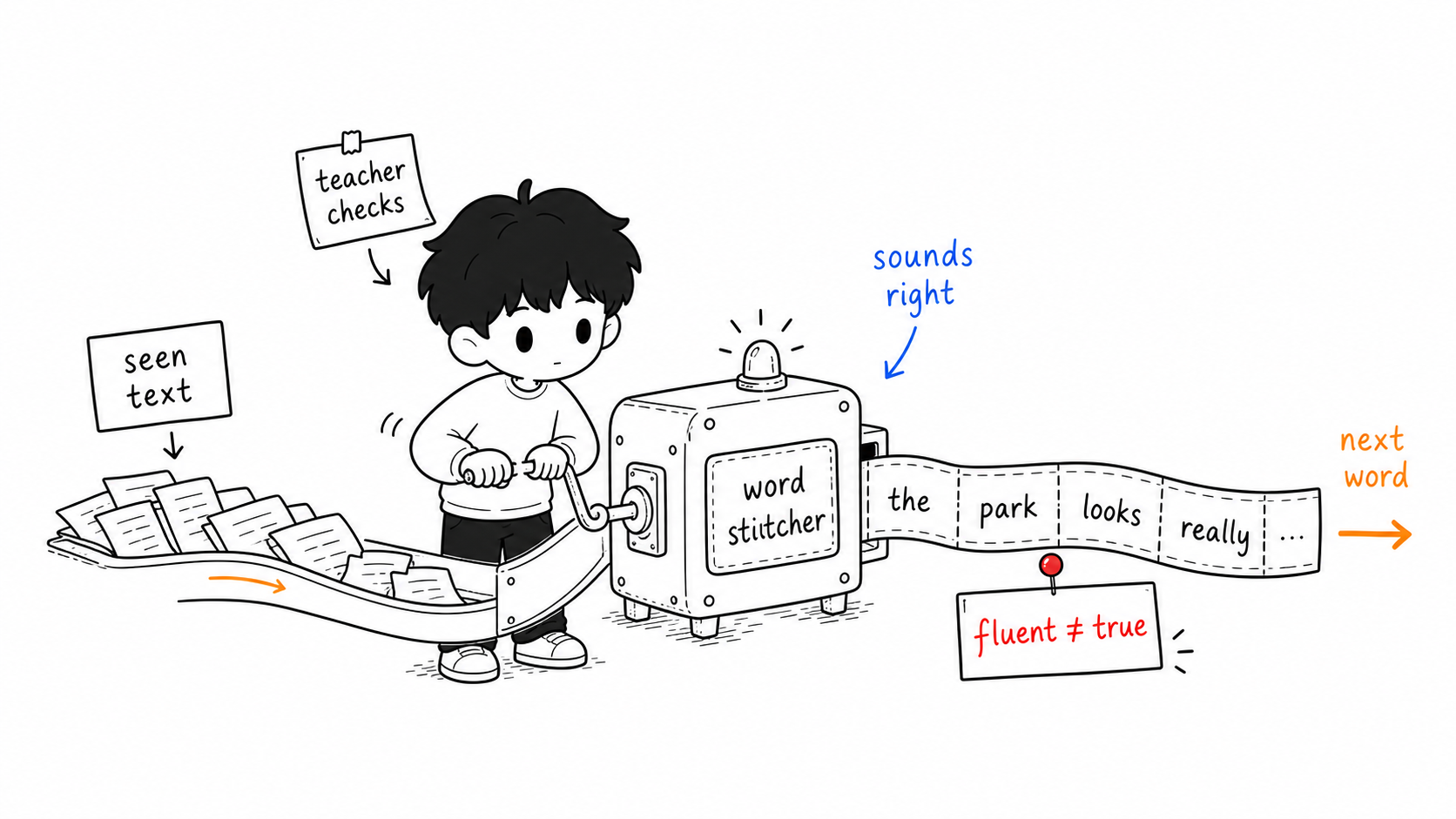
Here’s a classroom example. A language-arts teacher asks AI to “design an interactive segment for Zhu Ziqing’s essay ‘Spring’ (《春》),” and it quickly offers: “Have students close their eyes, play soft music, and guide them to imagine a spring breeze on their faces…” The design looks professional, because AI has seen huge amounts of similar teaching language and can mimic its style precisely. But AI doesn’t know how many students are in your class, whether the room is quiet, or whether some children simply can’t settle down. It generates “the thing most resembling a good answer,” not “a plan tailored to your particular class.” Judging whether it actually fits is always your job.
Why It Makes Mistakes: Three Risks to Watch For
Once you understand the “prediction” mechanism, AI’s typical errors are no longer mysterious—they become predictable.
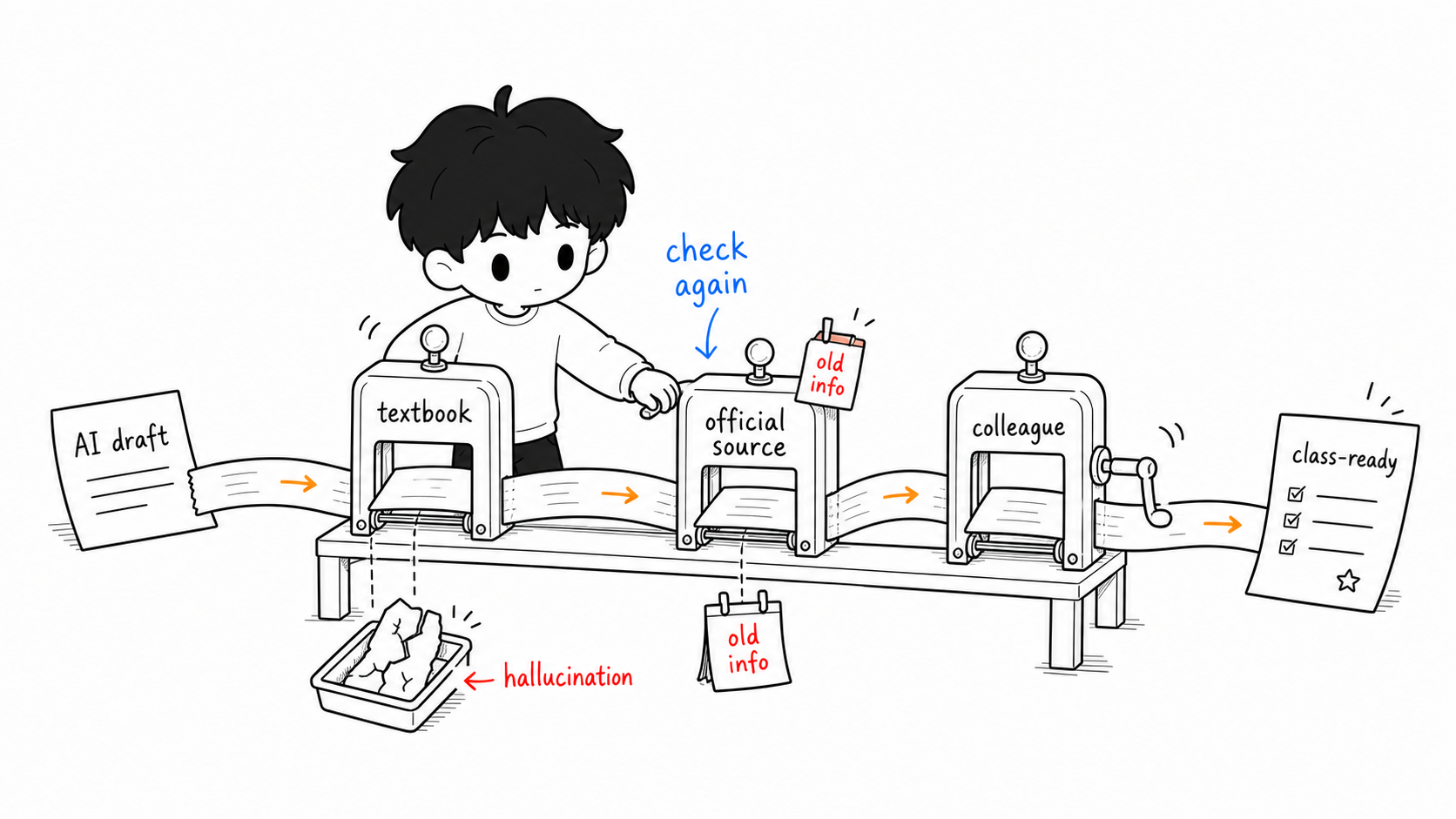
The first is hallucination, or stating something false with total composure. Because AI is stitching together “the most likely phrasing,” when it isn’t sure about some fact, it won’t stop to say “I don’t know”—it will fluently invent one. Ask it to introduce China’s “Four Great Inventions,” and it might confidently list “papermaking, printing, the compass, gunpowder, and the steam engine”—but the steam engine was a product of Britain’s Industrial Revolution and doesn’t belong on that list at all. The more natural the error, the more dangerous it is.
The second is outdated knowledge. Every model’s training data has a cutoff date, and in principle it doesn’t know what happened after that point. This matters especially for teachers: adjustments to curriculum standards, the latest policy documents, freshly updated textbook content—AI may well give you an old version. For core information involving curriculum standards and policy, always defer to the latest official documents rather than asking AI.
The third is hidden bias. AI learns from text humans have already written, and whatever stereotypes exist in human language, it learns—and sometimes amplifies—them as-is. Ask it to describe a “scientist,” and the image may be uniformly male; describe a “nurse,” and they may all be female. It isn’t deliberate, but without vigilance, these biases quietly slip into your courseware and your classroom.
These three risks share one trait: none is an occasional malfunction; all are natural results of how the technology works. So the way to deal with them isn’t to “wait for the technology to mature,” but to make verification a habit.
Why Verification Can Never Be Skipped
Since AI’s job is to “generate plausible content” rather than to “guarantee the content is correct,” the responsibility for vetting necessarily falls on the user. For teachers this matters all the more—you’re not just vetting a piece of text, but content that will be placed in front of students.
A simple, reliable habit is a three-step check: first cross-check against the textbook to see whether it matches the edition you’re teaching; then consult an authoritative source—an official education-ministry website, a formally published work—to confirm there are no hard factual errors; and when something remains uncertain, ask an experienced colleague. These three steps take little time, yet they block the vast majority of AI errors.
Going further, this kind of checking is itself excellent teaching material. You can treat AI-generated content as “text waiting to be debunked” and have students identify the errors and biases in it together—letting them see with their own eyes that even fluent, confident phrasing can be wrong. That’s far more powerful than simply telling them “AI makes mistakes,” and it’s exactly the capability the digital age most needs to cultivate.
The Takeaway of This Chapter
Condense this chapter into three lines: AI predicts, it doesn’t understand; fluency does not equal correctness; verification is the user’s responsibility, not an optional extra.
Remember these three points and you hold the key to using every AI tool well. Tools will keep updating and being replaced, but as long as you’re clear about where their capability boundaries lie, you remain the one at the helm. In the chapters ahead, we’ll build on this foundation step by step—how to choose a model, how to ask questions, and how to genuinely bring AI into everyday teaching.
This article is part of the A Teacher’s Guide to AI series. For specific sources, references, and AI-use notes, see the series index page.