In one sentence: when AI gives a poor answer, it’s usually not that it can’t, but that your question wasn’t clear enough. The quality of the question determines the quality of the answer.
Many teachers try AI and conclude “it’s nothing special”—ask it to design a lesson plan and get a pile of generalities; ask it for problems and they’re either above grade level or too easy; ask it for a homeroom-period plan and you’re served a bowl of preachy clichés no one wants to hear. The problem usually isn’t AI, but the way the question is asked. It’s like telling a new intern “go handle that project” without telling them what to do, for whom, or to what standard—naturally the result won’t be good.
This chapter gives you a general method. It depends on no specific tool—whether you use DeepSeek, Doubao, ChatGPT, or Claude, the logic of saying things clearly is the same. I suggest you open an AI as you read and try it on a task of your own.
The Three-Layer Method
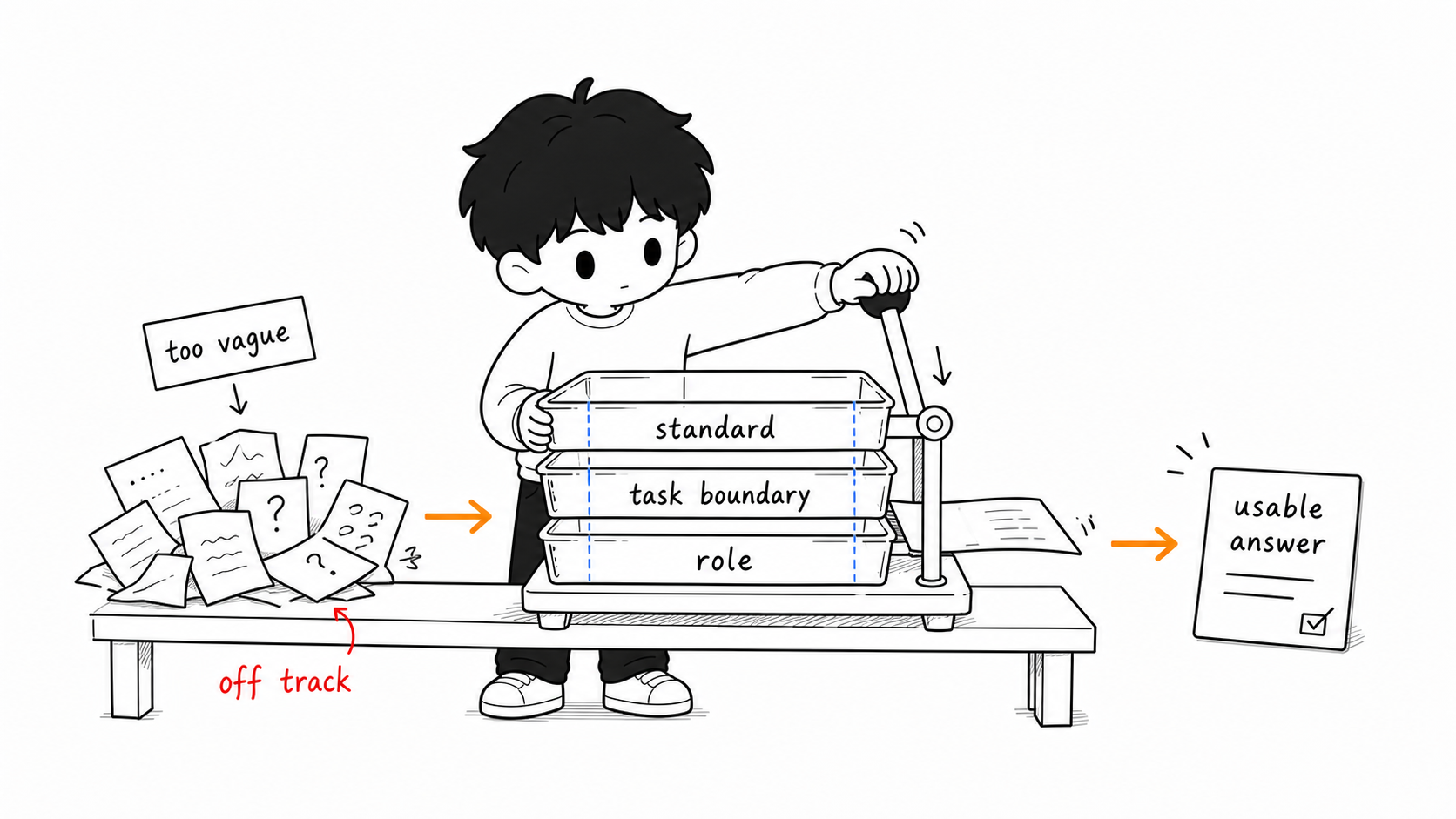
A usable prompt generally makes three things clear: who you want the AI to play, what you want it to do, and to what standard.
First layer: give it an identity. Don’t just say “please design a lesson plan”; first assign a role, such as “you are a middle-school language-arts teacher with ten years’ experience, skilled at sparking student interest through real-life situations.” Assigning an identity works because it makes the AI draw on the phrasing and knowledge associated with that role—like giving an actor a clear character, the performance comes out more on point.
Second layer: draw the boundaries of the task. Don’t just say “design a homeroom-period activity”; frame the audience, length, and goal: “Design a 40-minute themed homeroom period for Grade 7 that helps students understand the meaning of ‘responsibility,’ guiding discussion through real campus situations.” The clearer the boundaries, the less the AI strays.
Third layer: give the quality standard. Don’t just say “suitable for middle schoolers”; write out the acceptance criteria in your mind: “Language should be plain, avoiding abstract preaching; each segment kept within 8 minutes; include at least one group discussion; end with a short, strong close.” This step amounts to telling it in advance “how I’ll judge whether this passes.”
These three layers needn’t always be long, but the more important the task, the more worth stating them in full.
A Full Demonstration: From “Crash” to “Usable”
What the three-layer method looks like in practice becomes clear from a comparison.
First, a typical “crash” prompt:
Help me design teaching activities for "Spring."Asked this way, AI will mostly give you a routine flow of “read aloud—divide into sections—summarize the main idea”: correct but mediocre, and applicable to almost any text, with little help to you.
Now look at the same request with all three layers filled in:
You are a middle-school language-arts teacher with fifteen years'
experience, skilled at guiding students to appreciate the beauty of
prose through sensory experience.

Please design a 20-minute classroom segment on Zhu Ziqing's essay
"Spring" (《春》) for Grade 7 students, focused on developing
aesthetic appreciation.

Requirements:
1. Begin from the "spring breeze" passage;
2. Design an interactive moment where students close their eyes and
   engage their sense of touch;
3. Guide students to discover how the author conveys emotion through
   tactile description;
4. Provide 2 to 3 open-ended questions;
5. Language should be beautiful but understandable to students.
This version will give you a complete teaching chain—from awakening the senses, to close reading of the text, to aesthetic transfer—often with specific transition lines included. The difference isn’t that AI got smarter; it’s that you stated “what counts as good” in advance.
You can try this comparison right now on a lesson you’re teaching next week: first ask casually in one sentence, then ask again with the three-layer method, and put the two results side by side to see the difference.
Don’t Expect It Right the First Time: Treat It as a Conversation
A common beginner’s mistake is expecting the first reply to be perfect and starting over whenever it isn’t. A more efficient approach is to treat it as a back-and-forth, refining toward what you want on top of what you already have:
Round 1: (use the three-layer method to get a basic framework)
Round 2: The framework is good, but add a 5-minute group-sharing segment
         in the middle.
Round 3: The third question is too hard for Grade 7—swap it for one closer
         to their lives.
Round 4: Make the overall language more conversational, like a teacher
         talking in class.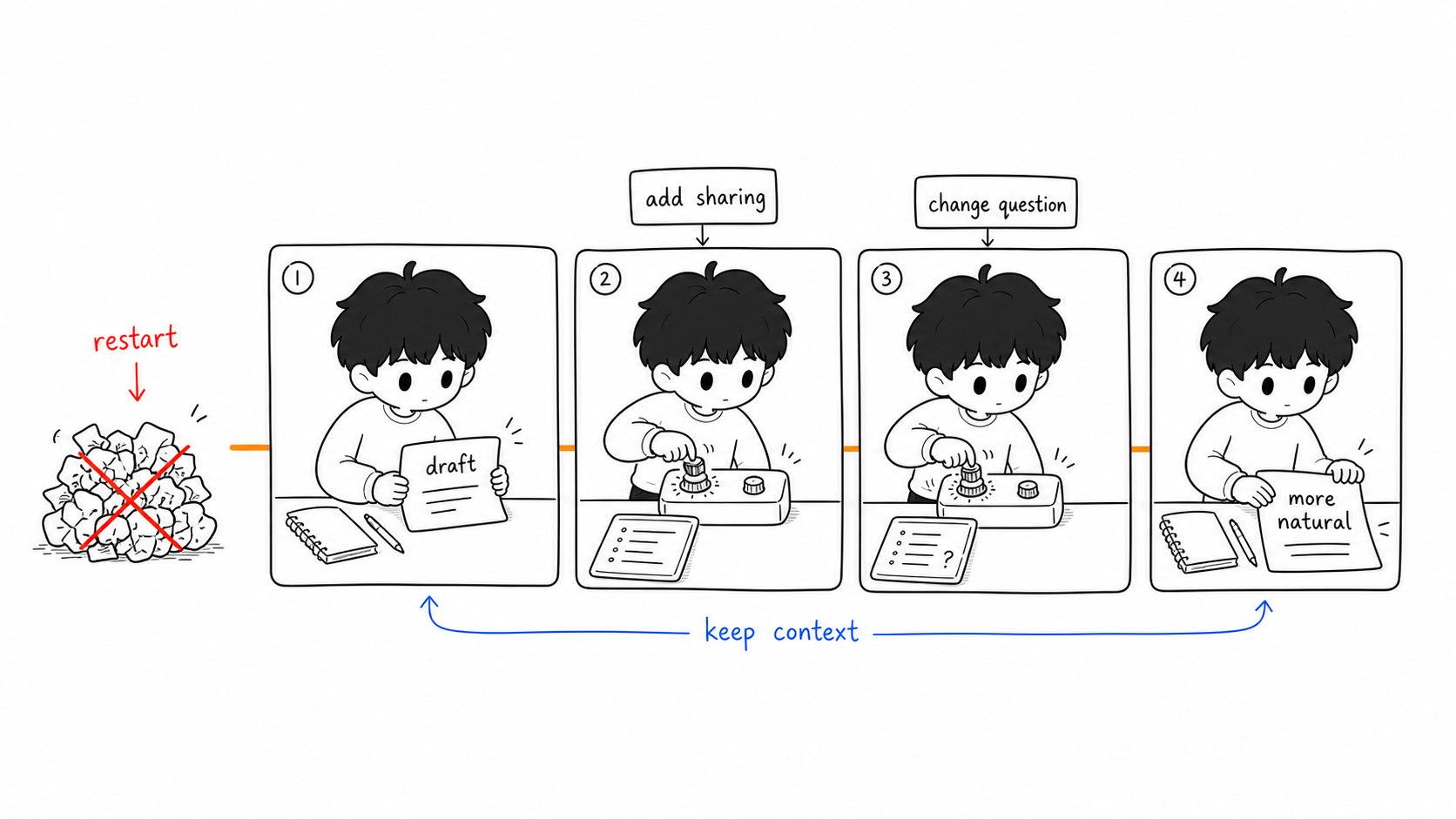
Each round changes just one thing, and AI revises while keeping the previous context, so you can also see the effect of each change more clearly. This kind of “iteration” is often easier than repeatedly rewriting one giant prompt—and it works better.
Two Advanced Moves to Make AI Understand You Better
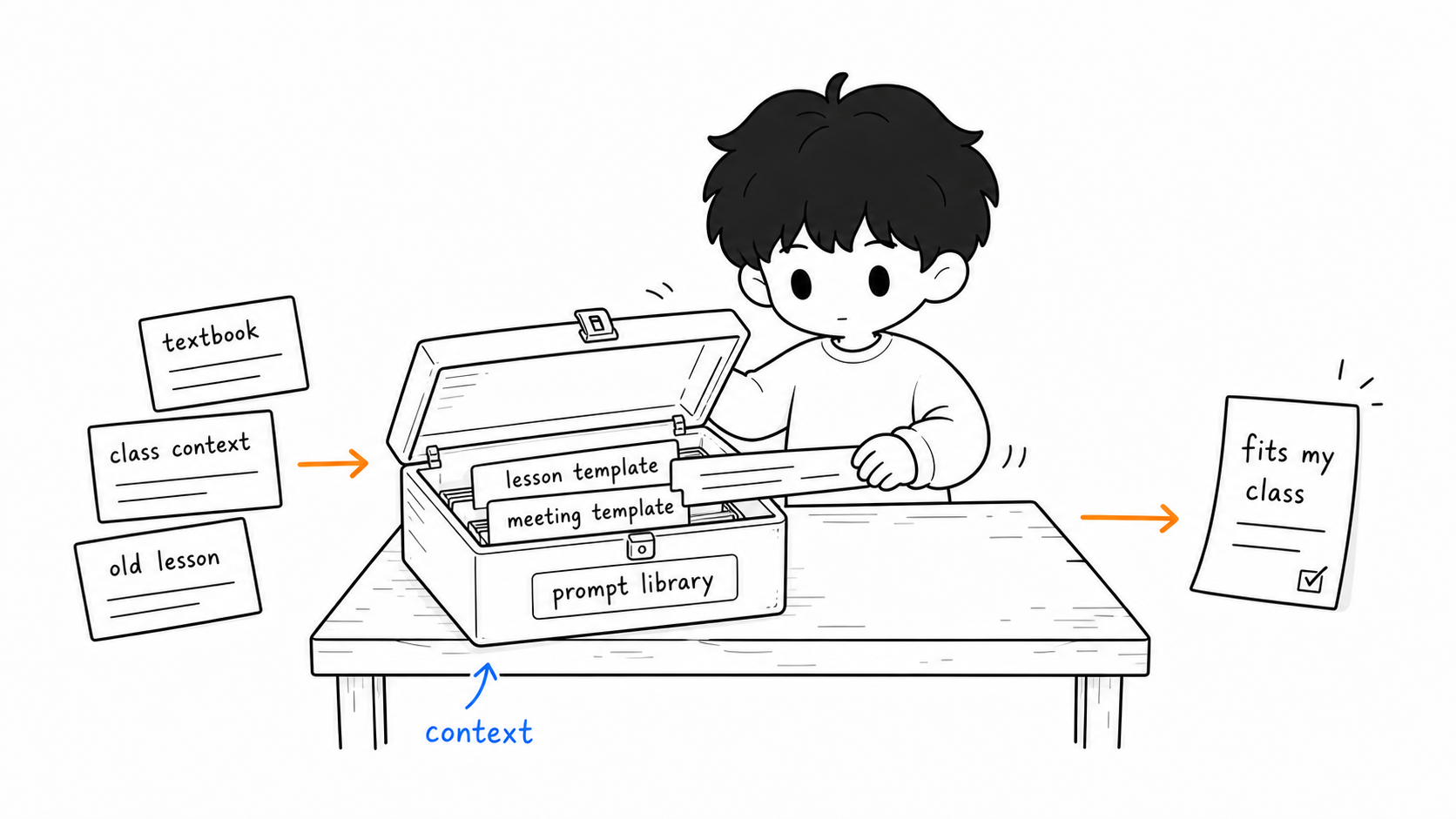
The first move is to feed it context. Most mainstream tools support uploading files or pasting long text. You can send it the textbook chapter you’re teaching and have it design activities based on the actual content; you can describe your class, such as “my class has 25 students, lively and active but easily distracted,” and have it adjust the pace accordingly; you can even send it a lesson plan you were happy with and have it mimic your style. The closer the context is to reality, the more directly usable the output.
The second move is to build your own prompt library. Save the prompts you’ve verified as effective, filed by subject or task type—a lesson-prep set, a homeroom set, a home-school communication set, a homework-design set. Next time you face a similar task, change a few keywords and reuse it. The longer you use it, the more valuable this library becomes; it gradually grows into a toolkit carrying your personal style. This dovetails neatly into the “workflows” of the next chapter.
What Prompts Can’t Replace
With the method covered, the boundaries also need drawing. Prompts can help you get a better first draft, more angles, and faster processing—but a few things they can’t give: they don’t understand what true responsibility and integrity are, so they can’t replace values guidance; they can’t produce genuine teacher-student emotional connection; the cognitive conflict that higher-order thinking requires still needs you to design. AI’s best role is “preparing material, offering perspectives, saving time”—turning material into education is always your job.
Teachers who know how to ask AI aren’t slacking off—they’re upgrading, just as a photographer picking up a camera isn’t replacing the eye but better preserving what the eye sees. Starting today, pick a simple task and try the three-layer method once, and record both the prompts that work and those that don’t—your prompt library is now open for business.
This article is part of the A Teacher’s Guide to AI series. For specific sources, references, and AI-use notes, see the series index page.