In one sentence: a classroom agreement settles “how my class uses it”; school policy settles “how the whole school stays consistent on fairness, safety, and bottom lines.” The two aren’t a matter of big versus small, but of different roles.
The last chapter was about the accord between teachers and students. But some questions can’t be settled by a single class or teacher: can AI actually be used in this exam? Does handing student grade data to AI for analysis count as a violation? If Class A treats AI assistance as normal while Class B counts it as cheating, is that fair to students? These questions of fairness, safety, and bottom lines need a unified school-level answer. This chapter is for school administrators and academic-affairs leads, about how to backstop scattered classroom practices with a school-wide consistent policy.
Step One: Judge Whether to Make Rules, and at What Level
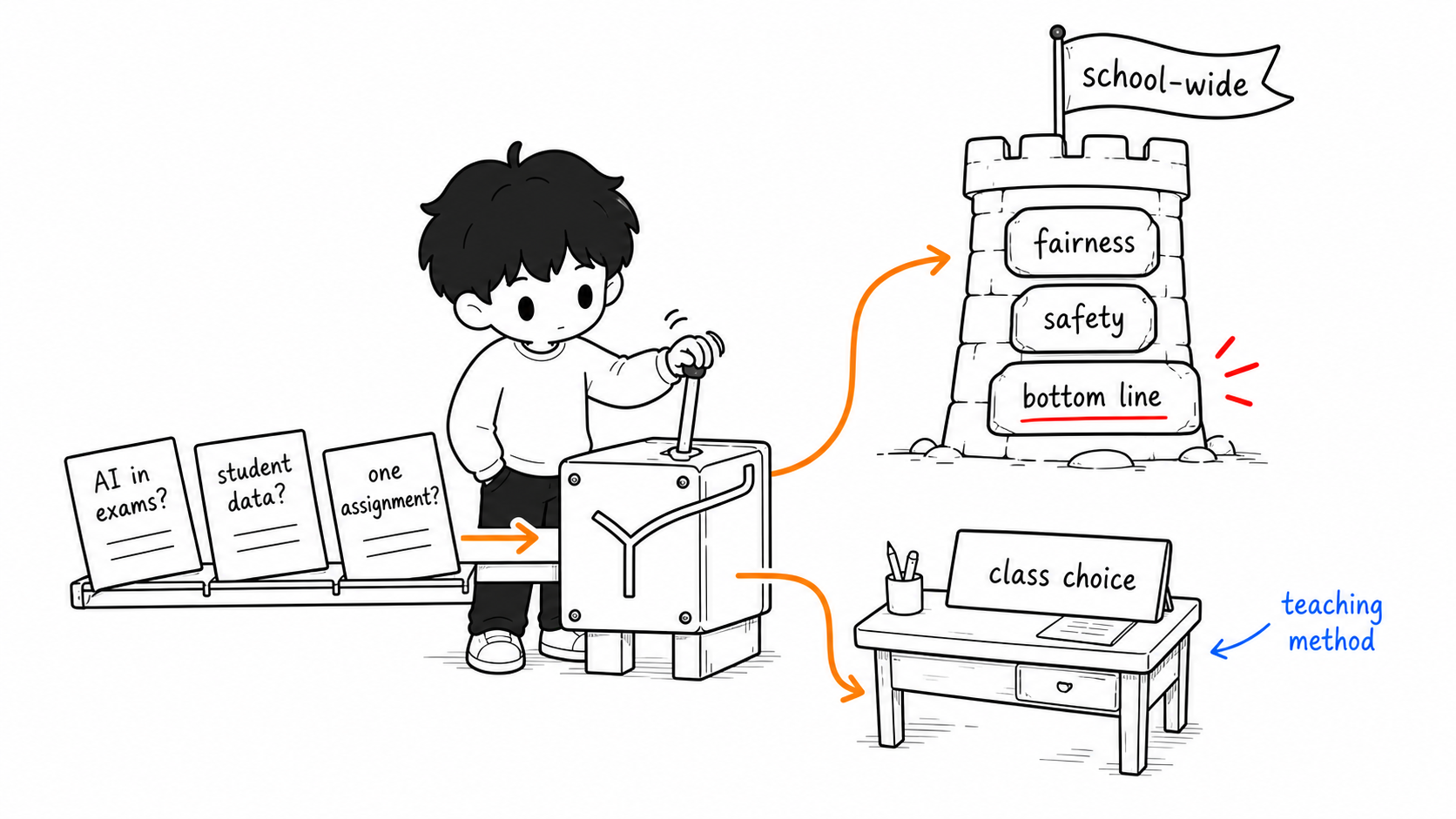
Not everything needs an official document, and not everything can be left to each class to decide on its own. Use the following order to judge which level a matter belongs to.
First ask: will it create unfairness between classes, or touch a safety bottom line? If so—say, whether AI can be used in exams, the protection of students’ personal data, the standard for determining academic integrity—then it should be set uniformly by the school, not left to each class’s own devices.
If not, ask further: is it a pedagogical choice of a particular course or class? If it is—say, how far AI assistance is allowed in this course’s homework, or how a given activity uses AI—leave it to the teacher to decide at the class level; the school needn’t overreach (this is exactly the previous chapter’s content).
Finally, if it’s just a one-off requirement for a specific task, there’s no need even to touch the classroom agreement; the teacher makes it clear when assigning. To sum up this decision line: the more a matter concerns fairness, safety, and bottom lines, the more it should rise to the school level; the more it’s a flexible pedagogical choice, the more it should be left to teachers. The value of school policy lies precisely in holding bottom lines and unifying standards, not in managing every teaching detail.
Step Two: What a School Policy Should Cover
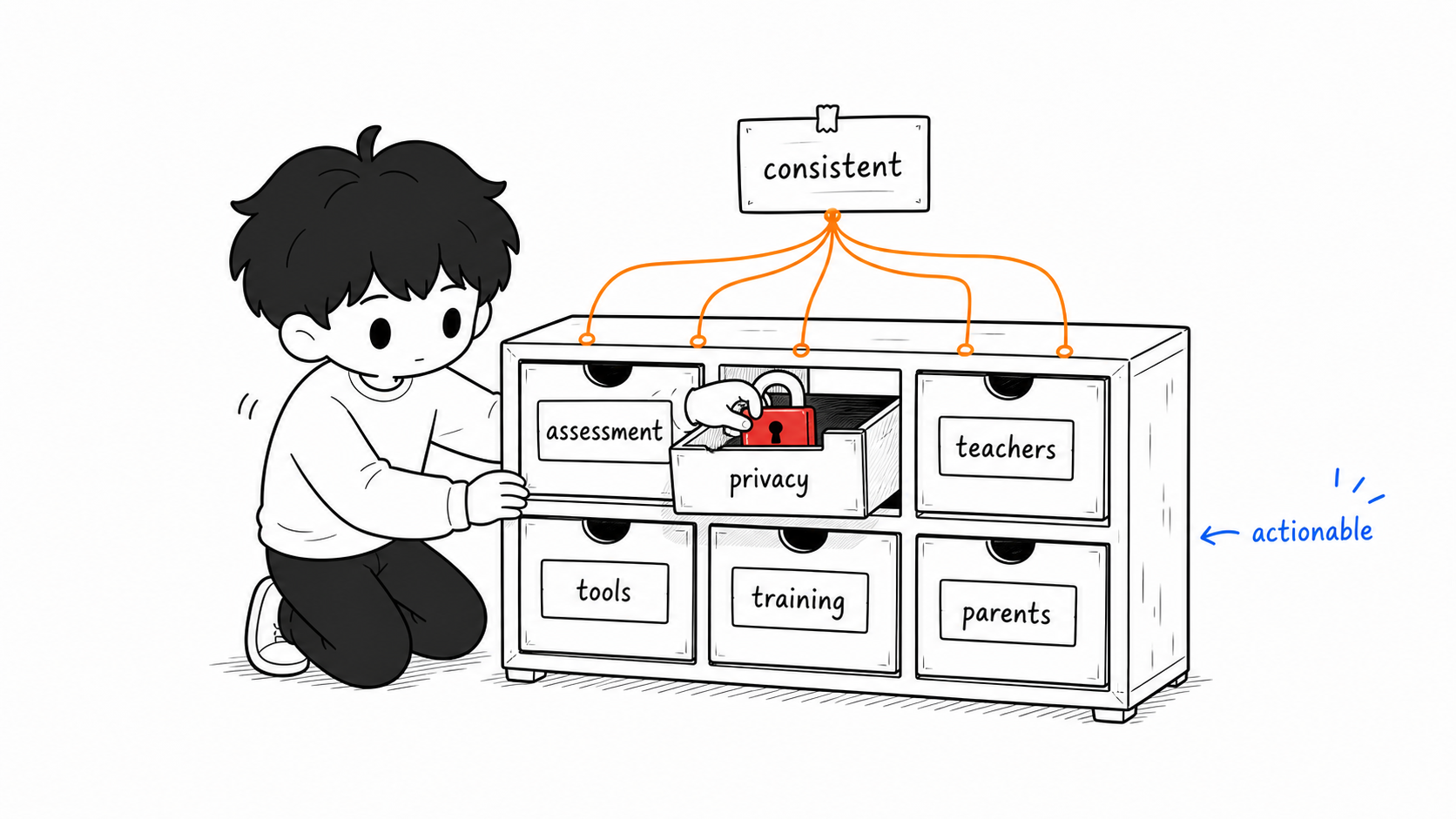
Having judged that a rule is needed, the next question is what to set. A thorough school AI policy usually needs to answer the following kinds of questions:
Norms for use in academic assessment. Which exams and which kinds of assignments explicitly forbid AI, and which encourage it with required annotation; how “over-reliance” and “academic misconduct” are determined. This is the part that most needs school-wide consistency, and the most likely to spark disputes without it.
Student data and privacy protection. Specify which information (names, grades, family circumstances, unreleased exam questions, etc.) must never be entered into any AI tool, require teachers and students to de-identify before use, and stipulate the range of usable and unusable tools. This is the red line the policy cannot blur; the reasons are in the ethics chapter.
Norms for teacher use. Teachers using AI for lesson prep, grading, and administration is the norm; the policy should both encourage it and draw boundaries: generated content must be verified before use in teaching, and handling of student data is equally subject to the privacy clauses.
Tool procurement and review. Before a school introduces or recommends any AI tool, there should be an evaluation step—where its data is stored, whether it’s suitable for minors, whether its content is reliable. Avoid tools of unknown provenance being brought in arbitrarily anywhere.
Teacher training and support. A policy can’t be only “prohibitions”; it must come with “enablement”: regular training, reference prompts and workflows, and a channel for questions—so teachers have the ability to execute the policy rather than being scared off by it.
A unified voice for home-school communication. The school should provide a unified explanation for parents, to avoid each class telling a different story, so parents understand the school’s stance and how families can cooperate.
Step Three: How to Get the Policy Made
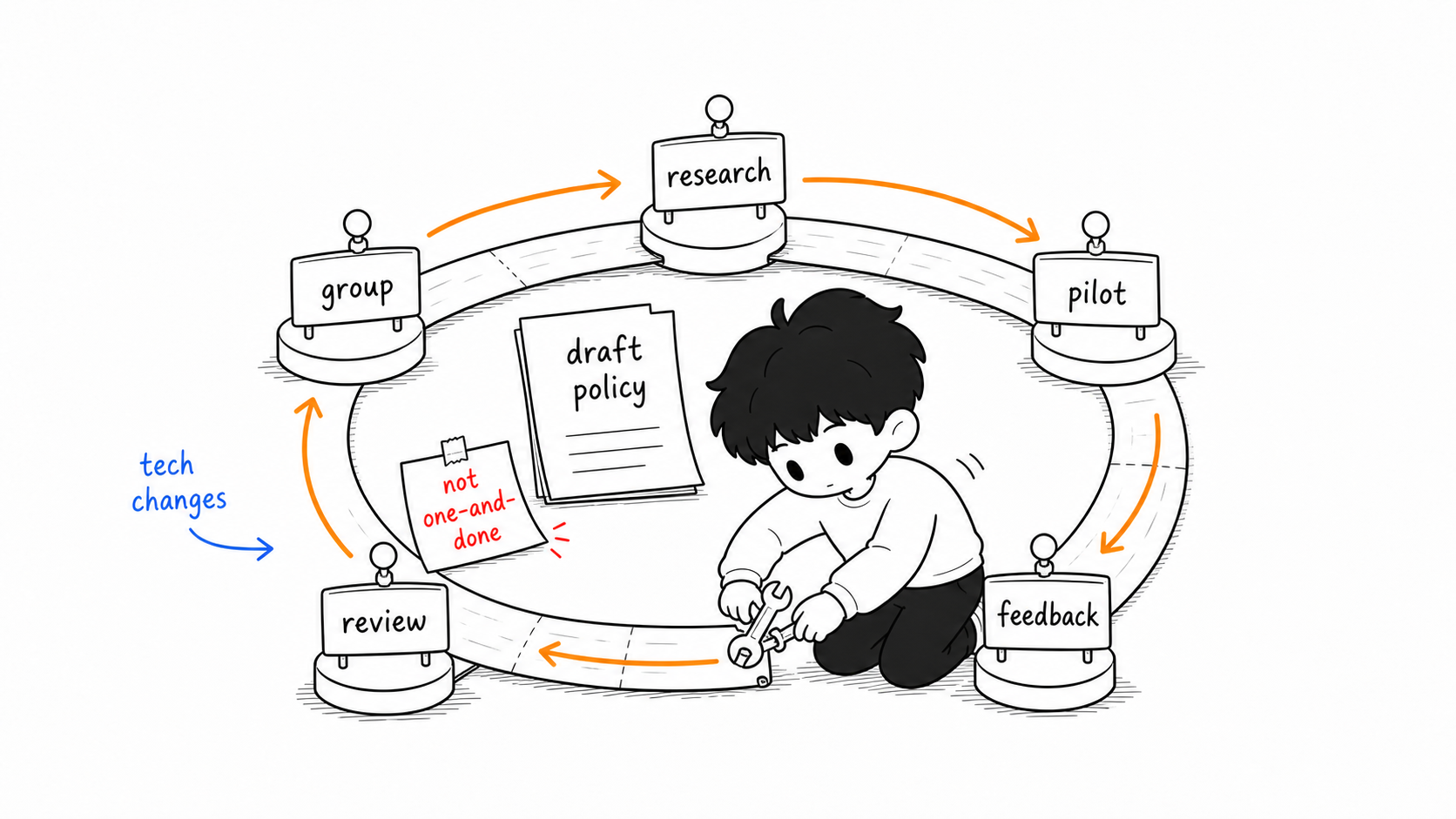
A policy shouldn’t be written behind closed doors by a few and then posted. A sounder process: first form a group that includes different subjects, information technology, moral education, and parent representatives, so the perspectives are full enough; then run a round of fact-finding to learn how teachers and students actually use AI, so the policy isn’t built on air; then draft and pilot it on a small scale, running it for a semester in one or two grades to collect problems; finally iterate on feedback before rolling it out school-wide. AI technology changes fast, so the policy should also build in a mechanism for regular review—don’t expect one version to last three years.
A Usable School-Policy Outline
The outline below can serve as a drafting skeleton, filled in to your school’s circumstances:
XX School Artificial Intelligence Use Policy (framework)

I. Purpose and principles
   State the school's basic stance on AI: education-first, encouraging
   responsible use, holding the three bottom lines of fairness, safety,
   and integrity.

II. Scope
   Who it applies to (teachers, students, administration) and in what
   scenarios.

III. Use in academic assessment
   · Types of exams and assignments where AI is forbidden
   · Situations where it's allowed and must be annotated
   · Determination and handling process for academic misconduct

IV. Data and privacy (red-line clauses)
   · List of information forbidden from being entered into AI
   · De-identification requirements before use
   · Range of usable / unusable tools

V. Norms for teacher use
   · Encouraged uses and the verification requirement
   · Rules for handling student data

VI. Tool procurement and review
   · Evaluation criteria and approval process for introducing new tools

VII. Training and support
   · Training arrangements, resource support, question channels

VIII. Home-school communication
   · Unified explanation for parents and suggestions for cooperation

IX. Review mechanism
   · Policy review cycle and responsible department

   Date issued: ____    Review date: ____
The End Point: Cultivating “Thinkers of the AI Age”
To close this chapter, and the whole series, in one line: whether it’s a classroom agreement or a school policy, what they ultimately point to isn’t “controlling whether students use AI,” but cultivating people who can discern the truth of information, who use tools well without depending on them, and who keep an independent personality and judgment amid the tide of technology.
Policies, agreements, and templates are only means; behind the means is the educator’s consistent judgment. From understanding how AI produces answers, to learning to ask questions, design workflows, and recognize agents, to holding the ethical line and setting good rules—along this whole road, the technology will keep updating, but as long as we keep judgment in our own hands, we remain the one at the helm, not the boat drifting with the current.
This article is part of the A Teacher’s Guide to AI series. For specific sources, references, and AI-use notes, see the series index page.