AI Guide for Teachers
A practical AI guide for frontline teachers, covering generative AI basics, asking better questions, vibe coding, AI agents, policy suggestions, and related materials.
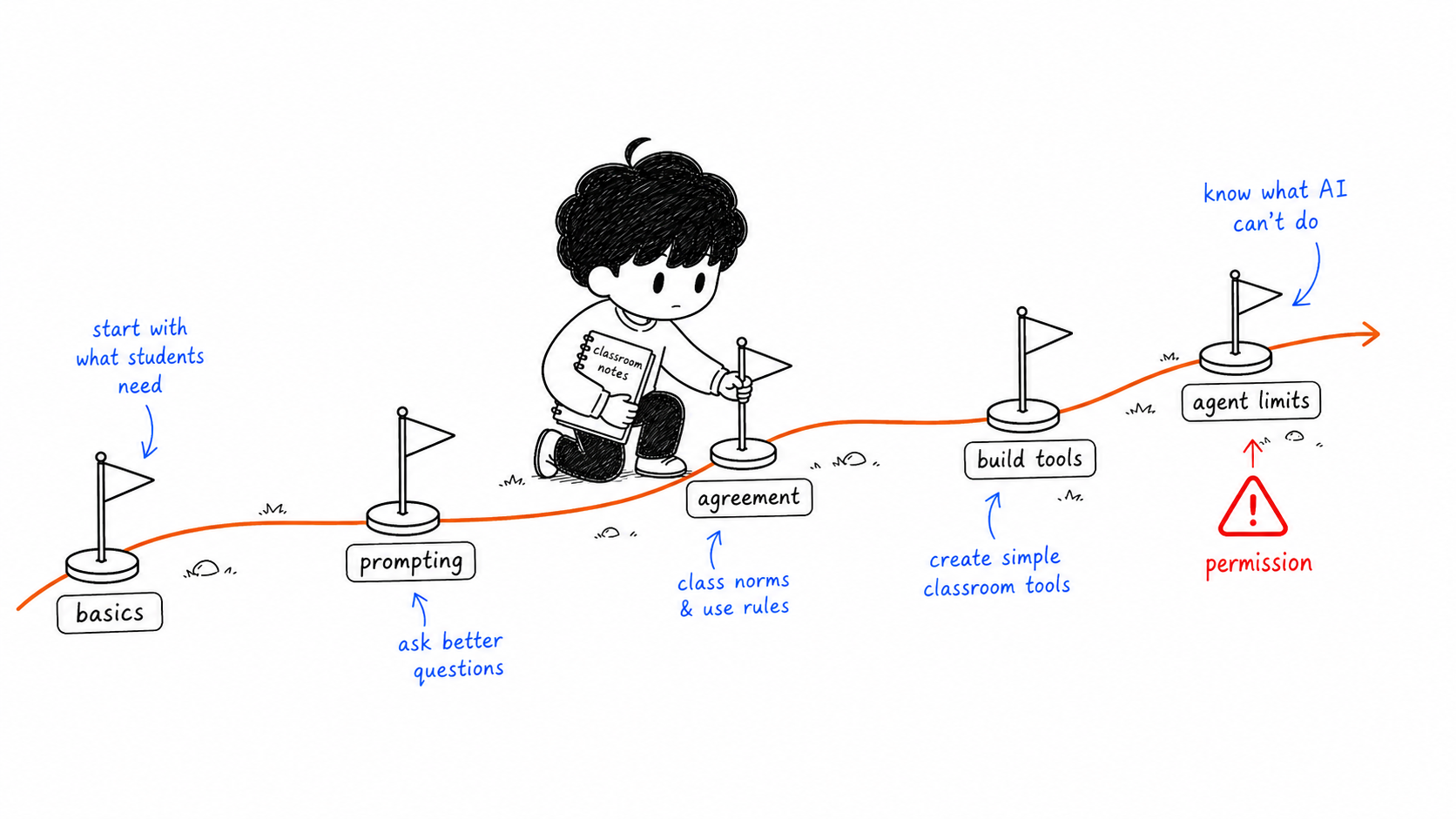
A Note Before Reading
This AI Guide for Teachers (《给老师的 AI 指南》) began as a set of English materials I wrote while serving as a teaching assistant for generative AI pedagogy at Barnard College in the United States. After returning to teach in China, I noticed that many colleagues felt the same way I did: curious but cautious about AI, eager to use it but worried about stepping into trouble.
So I decided to thoroughly “translate” that more academic English guide into a practical handbook that truly belongs to our teaching context: removing obscure terminology, adding local tools, adapting it to both Chinese and international school settings, and most importantly, making AI feel like a reliable intern at your side rather than a difficult new colleague.
The Chinese edition was rewritten and localized from the original English materials, aiming to make the ideas clear at a glance and maybe bring a knowing smile.
- The Ministry of Education’s 2025 Guidelines for Teachers’ Use of Generative AI, First Edition (《教师生成式人工智能应用指引(第一版)》)
- Tsinglan School Teacher Guide, 2025-2026 (清澜山学校教师指导手册(2025-2026学年))
This is not a policy document. It is a teaching companion meant to be useful. It does not dwell on grand narratives. It talks about small AI techniques you can use tomorrow, pitfalls you can avoid, and rules you can explain clearly.
You are welcome to read it with doubt, curiosity, or even a little anxiety, because real educational wisdom has never lived inside the technology. It lives in your hands.
Articles
- How AI Produces Answers: Foundational AI Literacy for Teachers
- Meet the Model Family: Choose by Capability, Not by Brand
- Say It Clearly: Prompt Engineering for Teachers
- You Don’t Need to Code to Build Tools: An Introduction to Vibe Coding
- From a Single Question to a Reusable Process: AI Workflows for Teachers
- From Conversation to Doing: Meet the AI Agent
- Think It Through Before You Use AI: The Ethical Questions Teachers Face
- A Classroom AI Agreement: Set the Rules Together with Students
- School AI Policy: From Whether to Make Rules, to What Rules to Make
Statement:The views in this guide come from English materials previously written by the author. Claude helped with structural organization and localization, and the illustrations were generated with Ze-Article-Illustrations Skill. The author edited and reviewed the content to support accuracy and readability. The final views and responsibility belong to the author.
Index
How AI Produces Answers: Foundational AI Literacy for Teachers
Before learning to use AI, teachers first need to understand how it produces answers, why it makes mistakes, and why verification can never be skipped. This is the foundation for everything else.
Meet the Model Family: Choose by Capability, Not by Brand
AI models aren't one thing but a family. Understand what large language, text-to-image, and text-to-video models each do well and poorly, and you can pick the right tool for every teaching task.
Say It Clearly: Prompt Engineering for Teachers
The essence of prompting isn't pleasing a particular tool—it's stating role, task, and standard clearly. Master this method and you can get usable results from any model.
You Don't Need to Code to Build Tools: An Introduction to Vibe Coding
The core of vibe coding isn't writing code—it's clearly stating your educational goal, interaction mechanics, and visual effect. Teachers focus on design; the technical details go to AI.
From a Single Question to a Reusable Process: AI Workflows for Teachers
What really saves time isn't one elegant question, but a process you can use over and over. Break the task down, set templates, divide human and AI labor, and place checkpoints—then AI can reliably work for you.
From Conversation to Doing: Meet the AI Agent
An agent is an AI that gets things done on its own. It can run a whole process for a teacher, but because it holds permissions it brings real risk. The true dividing line is still in the person.
Think It Through Before You Use AI: The Ethical Questions Teachers Face
Bias, privacy, academic integrity, copyright—these four problems won't vanish on their own as the technology advances. The teacher is at once a user, a gatekeeper, and a model.
A Classroom AI Agreement: Set the Rules Together with Students
For homeroom and subject teachers: rather than a blanket ban, work out a concrete, executable classroom AI agreement together with students. This chapter gives you openness tiers, a participatory process, and ready-to-use templates.
School AI Policy: From Whether to Make Rules, to What Rules to Make
For school administrators: what a classroom agreement can't cover needs a unified school-level policy. This chapter gives you a decision framework for whether to make rules and what to cover, plus a usable policy outline.