In one sentence: the wisdom of education lies not in what to forbid but in what to guide. At the classroom level, what you want isn’t a decree but an agreement students are willing to keep.
Students are already using AI—that’s the starting point for any classroom rule. Surveys show the vast majority use it, and a sizeable share instinctively ask AI first when they hit a problem. In the face of this reality, “to ban or not” is a false question; what really needs answering is “how to guide.” This chapter is for homeroom and subject teachers, about matters you can decide at the class and course level—more concrete and closer to your daily teaching than a school’s macro policy. (How school-level policy is set is the next chapter.)
Why a Blanket Ban Is Usually the Worse Move
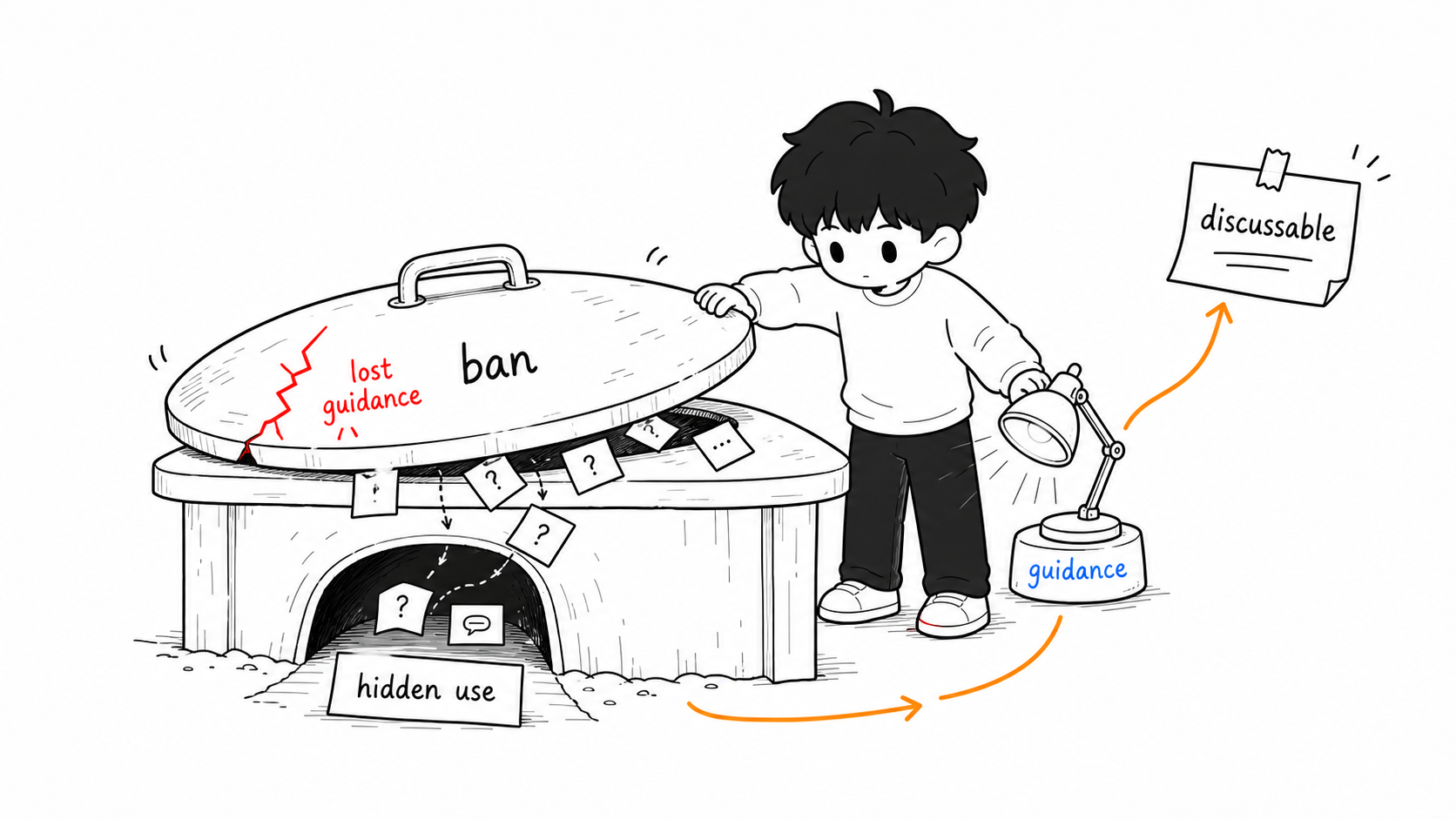
A total ban looks clean, but the cost is high. Students won’t stop using AI; they’ll just go “underground”—you lose the chance to guide, they lose the chance to be corrected; unguided use makes it easier for students to be misled by wrong information, and misses the key window for cultivating digital literacy; and once suspicion grows between teacher and students, the crack in trust is harder to repair than AI itself.
A more fitting analogy is teaching a child to use a knife: not hiding the knife away, but teaching the correct grip and boundaries. The aim of a classroom agreement isn’t restriction but making use transparent, discussable, and accountable.
Set Openness by Task, Not by Blanket Rule
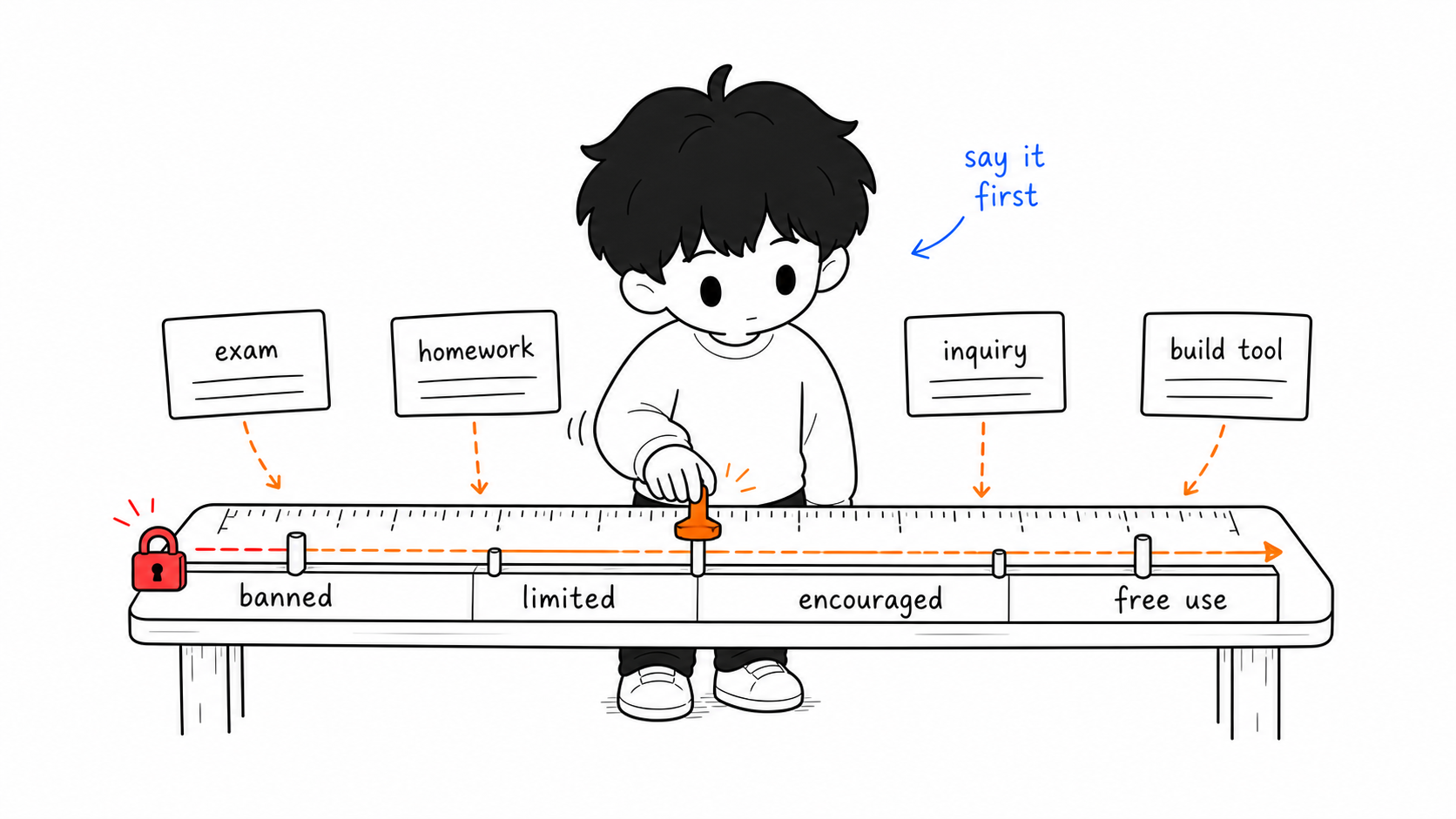
“Can AI be used” is too coarse a question. What’s really useful is to set a degree of openness for each type of assignment. The scale below, from tight to loose, helps you sort the various tasks in your class:
| Openness level | Applicable scenario | What’s required of students |
|---|---|---|
| Forbidden | Exams, timed work testing true ability | No use of AI at all |
| Limited | General assignments | Only for looking up material, explaining concepts, checking grammar; core content done by oneself, and annotated honestly |
| Encouraged | Inquiry-based, open-ended tasks | May use AI to expand ideas and gather inspiration, but must show one’s own processing and judgment, and annotate |
| Free | Tool/skill-based tasks (e.g., learning to make a small tool) | Treat AI as a regular tool; focus on the outcome and process |
The point isn’t choosing which tier is “most advanced,” but that for the same assignment, both you and the students know clearly which tier it belongs to. Stating the level when you assign the task is far more effective than retroactively interrogating “did you use AI?”
Have Students Participate, Not Passively Accept
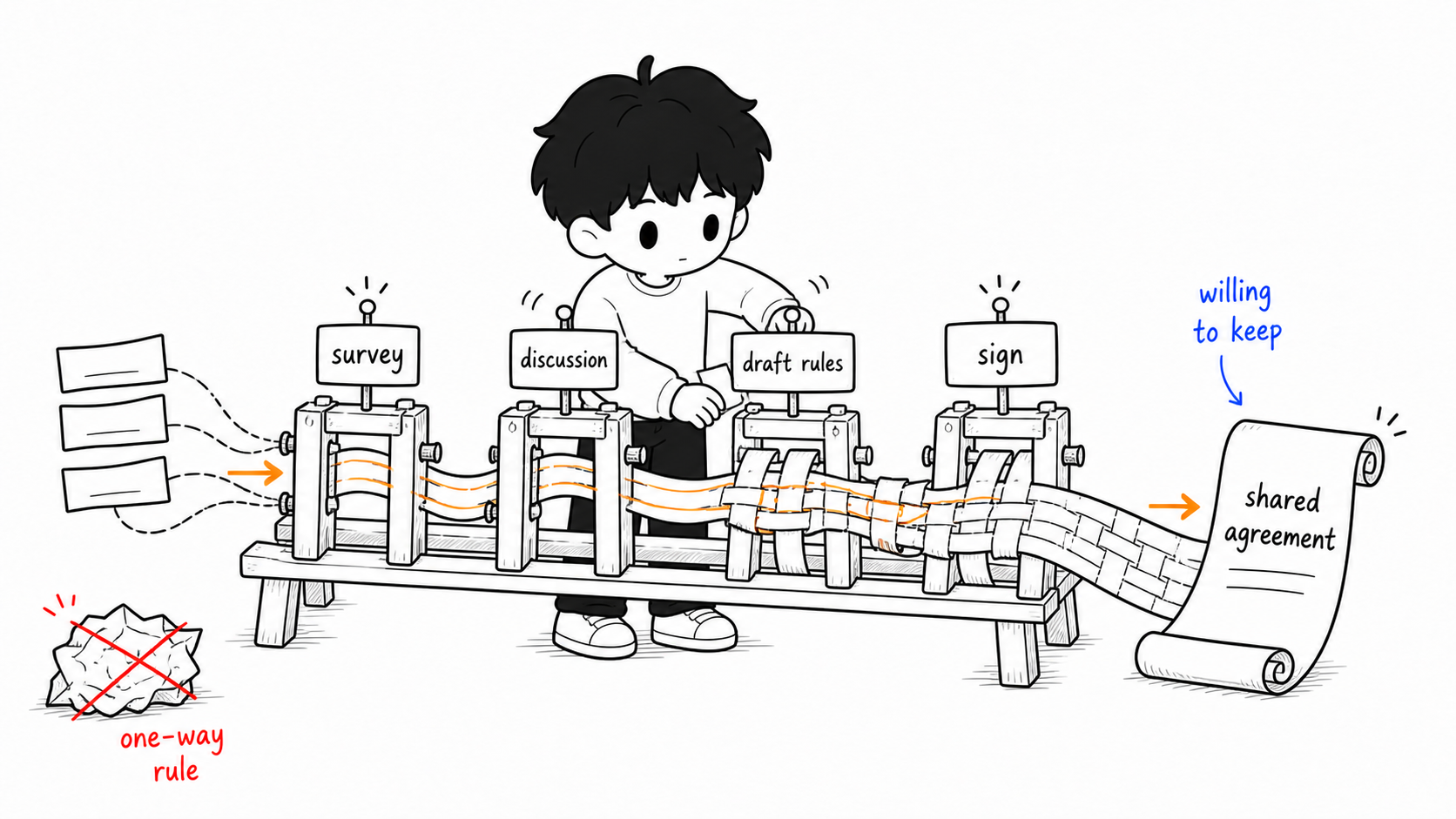
If a rule is handed down unilaterally, students will only think about how to get around it; if they set it together, the rule becomes an agreement they’re willing to uphold. A workable process: first use an anonymous survey to gauge the class’s real AI usage; then spend a homeroom period discussing “the value of thinking”—have students compare solving a problem themselves with reading AI’s answer directly, feeling the difference firsthand; then have groups draft clauses and the whole class vote; finally sign it formally, letting ceremony bring a sense of responsibility. One class, in this process, spontaneously proposed adding “no using AI to generate evaluations of classmates”—a clause whose weight a teacher couldn’t have dictated alone.
Ready-to-Use Templates
The three templates below can be copied and adapted to your class.
Classroom AI Agreement (framework):
Our Class's AI Use Agreement

I. Our shared understanding
   AI is a tool to help learning; independent thinking is the purpose of
   learning. We use AI to learn better, not to replace our own thinking.

II. Use it like this (encouraged)
   · Looking up background material, explaining concepts we don't understand
   · Checking the grammar and expression of essays
   · Getting different ideas and inspiration when stuck

III. Don't use it like this
   · Submitting complete AI-generated work
   · Believing facts from AI without verification
   · Disclosing one's own or classmates' private information to AI
   · Letting AI make the final judgment or decision for oneself

IV. Transparency principle
   Whenever AI was used, note it honestly per the annotation template.

   Signed by the whole class, ___________ Class    ____ / __ / __
Homework annotation template:
For this assignment I used [some AI] for help in the following parts:
1. ____________________
2. ____________________
I affirm that the core thinking and views are entirely my own.
Student signature: __________
Parent communication letter (key-points version):
Dear parents,

  This generation of children will grow up alongside AI. Our approach is
  not to forbid, but to teach them to use it responsibly—just as we once
  taught children to discern online information rather than banning the
  internet.

  At home, rather than asking "did you use AI," it's more effective to ask
  three questions: "Did you think about this problem yourself first?"
  "What did AI suggest?" "Why did you choose this way?"

  You're also welcome to do a small task together with your child using AI
  over the weekend, to see its abilities and limits firsthand. Together,
  let's help children both use the tool well and hold on to their thinking.

                                          Homeroom teacher   ____
What to Do About Violations: Education First
When a student crosses the line, the keynote is education, not punishment, handled by degree: for minor cases like forgetting to annotate, a verbal reminder and adding the annotation will do; for general cases like over-reliance, have them redo it and write a short reflection; for serious cases involving academic misconduct, then move to parent communication and a joint improvement plan. At every level, talking privately and asking the reason first (“Why did you choose to use AI for this at the time?”) solves the problem better than public criticism.
In Brief
A classroom agreement is an accord between you and your students; the more concrete it is and the more everyone sets it together, the better it works. Tier openness by task, have students participate in setting it, use templates to put transparency on paper, and treat violations with education first—work through these four steps and your class has a set of AI rules that can actually be implemented.
But some matters can’t be decided by one class or one teacher alone—whether AI may be used in exams, how student data is protected, how a school-wide integrity standard is unified. These need to rise to the school level, which is exactly what the next chapter discusses.
This article is part of the A Teacher’s Guide to AI series. For specific sources, references, and AI-use notes, see the series index page.